What the trial showed
In the SURPASS-2 (phase 3, head-to-head vs Ozempic) trial, −2.46% a1c reduction at 15 mg (vs −1.86% ozempic 1 mg) over 40 weeks.
Mounjaro is a GIP/GLP-1 dual receptor agonist used for Type 2 diabetes.
Mechanism of action
- Pivotal trials
- 1
- Phase 3
- Participants
- 1,879
- across all trials
- Publication years
- 2021
- peer-reviewed
Last Revised — by Dr. Jane Novak, MD, MPH
SURPASS-2 (phase 3, head-to-head vs Ozempic)
- • Tirzepatide 5/10/15 mg vs semaglutide 1 mg, both weekly in T2D.
- • Tirzepatide outperformed at every dose; 15 mg achieved 86% A1C <7%.
- • Weight loss 7.6-11.2 kg (tirzepatide) vs 5.7 kg (semaglutide).
Weight-loss trajectory · SURPASS-2 (head-to-head vs semaglutide 1 mg)
Mean change in body weight over the 40-week trial.
What the evidence supports — Mounjaro
Editorial grades summarizing study quality and convergence. How we grade.
| Claim | Grade | Basis |
|---|---|---|
Greater A1C reduction than semaglutide in head-to-head trial Source: NEJM, 2021 (opens in a new tab) SURPASS-2 (n=1,879), prespecified superiority at all 3 doses | AStrong evidence | SURPASS-2 (n=1,879), prespecified superiority at all 3 doses |
Causes 15-22% body-weight reduction in adults without diabetes (Zepbound label) Source: NEJM, 2022 (opens in a new tab) SURMOUNT-1 (n=2,539), dose-dependent | AStrong evidence | SURMOUNT-1 (n=2,539), dose-dependent |
Reduces cardiovascular events in adults with T2D SURPASS-CVOT trial enrolled but full results pending; mechanism plausible from class data | CLimited evidence | SURPASS-CVOT trial enrolled but full results pending; mechanism plausible from class data |
Improves obstructive sleep apnea (AHI) in adults with obesity Source: NEJM, 2024 (opens in a new tab) SURMOUNT-OSA two trials showed ~25-30 events/hour AHI reduction | BModerate evidence | SURMOUNT-OSA two trials showed ~25-30 events/hour AHI reduction |
Mounjaro dose-titration ladder
Step up every 4 weeks. Three valid maintenance doses (5, 10, 15 mg) — match the dose to the side-effect tolerance, not just the A1C target.
Weeks 1–4
2.5 mg
Starter — tolerance building
Weeks 5–8
5 mg
First therapeutic step
Weeks 9–12
7.5 mg
Optional step
Weeks 13–16
10 mg
Common maintenance
Weeks 17–20
12.5 mg
Optional step
Weeks 21–52
15 mg
Highest-efficacy maintenance
Target dose
Source: Mounjaro prescribing information (opens in a new tab)
FDA approval
2022
Type 2 diabetes
Max dose
15 mg
Weekly injection
A1C drop
up to 2.4%
SURPASS data
List price
$1,135
/month cash
Monthly cost in the US
What Mounjaro costs by payment path
Real out-of-pocket varies. Cash list price is what the pharmacy bills without insurance. Commercial copay assumes a tier-3 specialty plan. Savings-card numbers come from manufacturer programs.
$1,023.04/mo
What you pay at the pharmacy with no insurance, no coupons.
$25–$200/mo
Typical tier-3 specialty copay if your plan covers GLP-1s for your indication. Coverage is uneven.
$1,023.04$25–$25/mo
Commercially insured with coverage for T2D — $25/mo, max savings $150/fill. Not for Medicare/Medicaid.
Prices verified against manufacturer pages and FDB pharmacy data. Last reviewed: 2026. Affordability programs change; verify eligibility directly with the manufacturer before assuming you qualify.
Pick your plan tier + deductible status for a tier-average estimate. Tap to expand.
What patients reported on Mounjaro
Patient-reported outcomes from the SURPASS program patient-reported outcomes substudy, plus the Drugs.com community satisfaction rating. These are aggregate signals, not individual testimonials.
A1C reduction
-2.3%
Mean A1C change vs baseline (15 mg dose, SURPASS-2)
Lost ≥10% weight
50%
15 mg arm — secondary endpoint of SURPASS-2
Lost ≥15% weight
27%
15 mg arm — depth of response in T2D
Treatment satisfaction
+8.4
DTSQ score advantage vs semaglutide 1 mg (SURPASS-2)
Drugs.com community rating from 638 verified user reviews. View on Drugs.com → (opens in a new tab)
Source: SURPASS-2 trial substudy + Drugs.com community rating accessed 2026.
Check Mounjaro against another medication
Already taking something else? Look up interactions.
Type a medication you currently take. We'll route you to the full interaction report — and you should still confirm with your prescriber before changing anything.
Powered by FDA prescribing information cross-references. Not medical advice — for anything serious, call your prescriber or 911.
Supply normal · as of 2026-05-01
This is general drug information, not medical advice. Talk to a licensed clinician before starting, stopping, or switching medication.
FDA supply status
AvailableReason: Previously: demand increase. Resolved Q4 2024.
Last verified May 15, 2026. Source: FDA Drug Shortage Database.
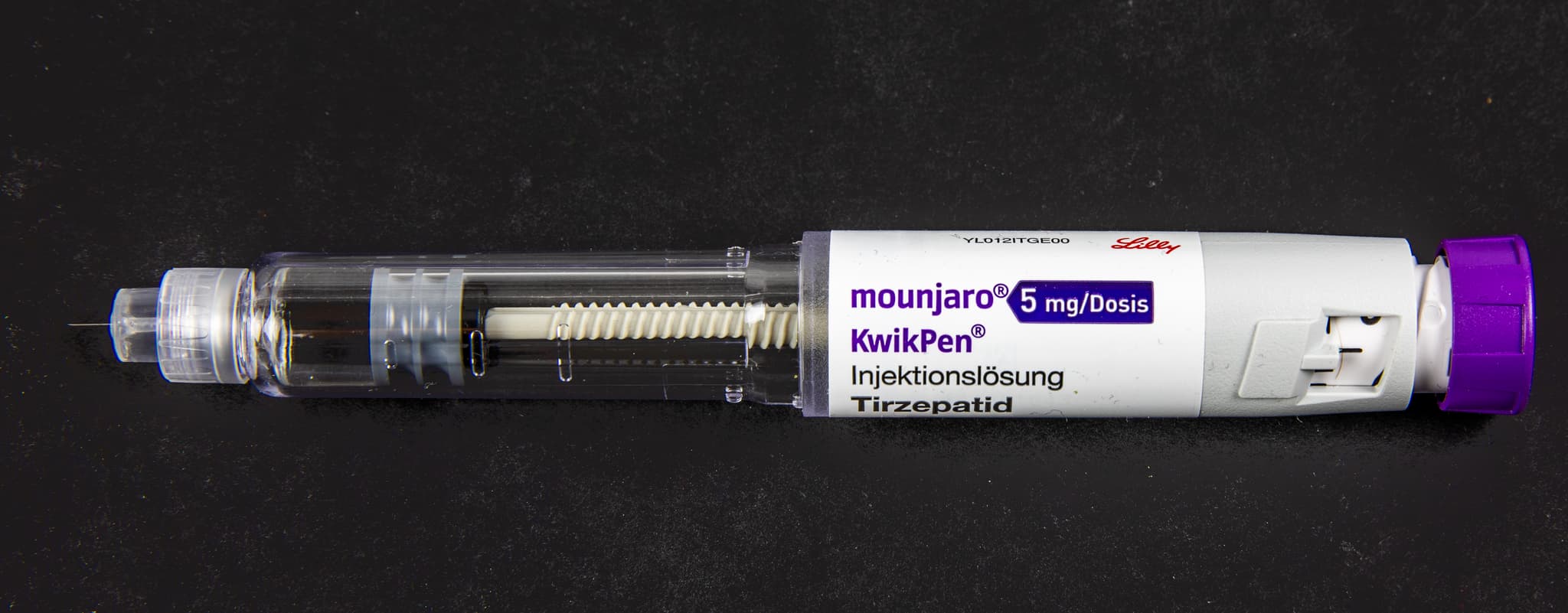
Why is Mounjaro prescribed?
Mounjaro is FDA-approved to treat:
- Type 2 diabetes
Dosing schedule
FDA-label titration timeline for Mounjaro. Doses ramp gradually to limit gastrointestinal side effects; never accelerate the schedule without prescriber input.
Step 1
Weeks 1–4
2.5 mg
Step 2
Weeks 5–8
5 mg
Step 3
Weeks 9–12
7.5 mg
Step 4
Weeks 13–16
10 mg
Step 5
Week 17+
15 mg
Maintenance
Source: FDA prescribing information. Weekly subcutaneous injection. Dose escalation may be delayed if side effects are intolerable. Doses listed here are typical; your prescriber may adjust based on tolerance and response.
Titration schedule
Weekly dose progression
Each escalation holds 4 weeks before the next step up — standard pattern across GLP-1 weight-management labels.
Clinical trial results
Body-weight outcomes from the pivotal trials that anchor FDA approval. Each chart plots the active arm against the placebo or head-to-head comparator, week by week.
SURPASS-2
Tirzepatide 15 mg subcutaneous weekly (vs semaglutide 1 mg)
Change in A1C from baseline at week 40 (non-inferiority of tirzepatide vs semaglutide 1 mg)
- Duration
- 40 wk
- Active arm
- n=470
- Placebo arm
- n=469
- Final delta
- -11.2%
Key takeaways
- Head-to-head with semaglutide 1.0 mg in T2D: tirzepatide-15 produced -11.2% body-weight change vs -5.7% with semaglutide.
- A1C reduction was -2.30% with tirzepatide-15 vs -1.86% with semaglutide-1; non-inferiority and superiority both met.
- GI adverse events (nausea, diarrhea) similar across arms — most resolved during dose escalation.
Side effects by frequency
Incidence rates for Mounjaro from the FDA prescribing information and pivotal trials. Numbers are active arm vs. placebo — the gap tells you how much of an effect is drug-caused vs. background.
- moderateNauseaGastrointestinal
- Active arm
- 29.6%
- Placebo
- 9.5%
Excess vs placebo: +20.1 pp
- moderateDiarrheaGastrointestinal
- Active arm
- 23.0%
- Placebo
- 7.3%
Excess vs placebo: +15.7 pp
- moderateVomitingGastrointestinal
- Active arm
- 12.6%
- Placebo
- 1.7%
Excess vs placebo: +10.9 pp
- mildConstipationGastrointestinal
- Active arm
- 11.7%
- Placebo
- 3.4%
Excess vs placebo: +8.3 pp
- mildDyspepsia (indigestion)Gastrointestinal
- Active arm
- 9.5%
- Placebo
- 1.9%
Excess vs placebo: +7.6 pp
- mildAbdominal painGastrointestinal
- Active arm
- 5.6%
- Placebo
- 4.2%
Excess vs placebo: +1.4 pp
- mildInjection-site reactionsSkin & injection site
- Active arm
- 5.2%
- Placebo
- 1.1%
Excess vs placebo: +4.1 pp
- severeHypoglycemia (with insulin/sulfonylurea)Metabolism
- Active arm
- 3.5%
- Placebo
- 1.4%
Excess vs placebo: +2.1 pp
- severeGallbladder disorderLiver & gallbladder
- Active arm
- 1.6%
- Placebo
- 0.6%
Excess vs placebo: +1.0 pp
- severeAcute pancreatitisGastrointestinal
- Active arm
- 0.2%
- Placebo
- 0.2%
Excess vs placebo: 0.0 pp
"Excess vs placebo" is the percentage-point difference between active treatment and placebo arms. A small excess (e.g., headache at +2.6 pp) suggests the side effect is mostly background noise, not drug-caused. A large excess (e.g., nausea at +28 pp) is a strong drug signal.
Sources
- SURMOUNT-1 (Jastreboff et al., NEJM 2022)
Trial percentages are population averages. Your individual experience may differ. Severity labels reflect typical clinical impact, not how it will feel for any specific patient.
Use & safety
Pregnancy
C — Discontinue at least 1 month before a planned pregnancy.
Breastfeeding
Not recommended while breastfeeding.
Missed dose
If within 4 days: take as soon as remembered. If more than 4 days: skip and resume normal schedule.
Storage
Refrigerate before first use. After first use, room temperature up to 21 days.
What Mounjaro costs in 2026
From $349/mo via telehealth66% off retail
Average retail in the US: $1023/month. We compare 4 pricing paths below so you can see exactly where the savings come from.
| Pricing path | Monthly cost |
|---|---|
Retail pharmacy Cash, no insurance, no coupon | $1,023 |
GoodRx coupon Same pharmacy, public coupon | $1,023 |
Commercial insurance Typical copay (median) | $25 |
Ro Cheapest editorially-vetted path | $349 66% off retail |
RxNorm Code: 2601723
Conditions it treats
FDA-approved or commonly prescribed off-label for these conditions.
Type 2 diabetes(T2D)
Type 2 diabetes is a chronic condition in which the body either resists insulin or does not produce enough of it to maintain normal blood glucose. GLP-1 receptor agonists are recommended injectable add-on therapy when A1C target is not met on metformin, and lower A1C by 1.0-2.0 percentage points on average.
Learn about Type 2 diabetesObstructive sleep apnea(OSA)
Obstructive sleep apnea (OSA) is a chronic condition in which breathing repeatedly stops and starts during sleep due to airway collapse. In December 2024 the FDA expanded Zepbound's indications to include moderate-to-severe OSA in adults with obesity — the first weight-loss drug approved for the condition.
Learn about Obstructive sleep apneaPolycystic ovary syndrome(PCOS)
PCOS is the most common endocrine disorder in women of reproductive age, affecting roughly 8-13% globally. It is characterized by irregular menstrual cycles, excess androgens, and polycystic ovaries. GLP-1 medications are increasingly used off-label for the obesity and insulin-resistance components of PCOS.
Learn about Polycystic ovary syndromeNAFLD / MASH(NAFLD)
Non-alcoholic fatty liver disease (NAFLD), now often called metabolic dysfunction-associated steatotic liver disease (MASLD), is the most common chronic liver disease in the US. The progressive inflammatory form (MASH, formerly NASH) can lead to cirrhosis. GLP-1 medications show emerging benefit for both weight loss and direct liver effects.
Learn about NAFLD / MASHMore on Mounjaro
Reader reviews
Verified user experiences with Mounjaro. Reviews are moderated before publishing.
No user reviews yet
Be the first to share what worked — side effects, titration experience, dosing, weight-loss timeline. The form below takes ~2 minutes.
Sources & further reading
All clinical claims on this page are sourced from the FDA prescribing information and peer-reviewed literature. Verify the most current label before clinical decisions.
- FDA prescribing information for Mounjaroaccessdata.fda.gov (opens in a new tab)
- DailyMed structured label (tirzepatide)dailymed.nlm.nih.gov (opens in a new tab)
- Peer-reviewed trials & meta-analyses (tirzepatide)pubmed.ncbi.nlm.nih.gov (opens in a new tab)
- Manufacturer page — Eli Lillymanufacturer site (opens in a new tab)
See our data sources of truth and the consolidated references bibliography for every claim cited above.
Related medications
Other drugs in the same class — GIP/GLP-1 dual receptor agonist.
Starting Mounjaro — what to expect, week by week
Week 1-4
2.5 mg starter dose
Sub-therapeutic for glucose — primarily about GI tolerance. Most people experience mild nausea and slight appetite reduction.
Week 5-8
Step to 5 mg — first therapeutic dose
A1C begins to fall (typically 0.7-1.0 points). Weight loss starts at 0.5-1 lb/week. GI side effects often peak in this window.
Week 9-20
Continued titration to 10-15 mg
Most additional benefit at 10-15 mg. Weight loss accelerates (1-2 lb/week). Continue careful step-ups every 4 weeks.
Week 20+
Maintenance at 5, 10, or 15 mg
Three approved maintenance doses. 15 mg is the highest-efficacy option; 5 mg is the lowest-side-effect maintenance.
Mounjaro — three things to settle first
Myth
Mounjaro and Zepbound are different drugs.
Fact
Same molecule (tirzepatide), same dose strengths. Mounjaro is FDA-approved for type 2 diabetes; Zepbound is approved for weight management. Lilly chose distinct brands to keep insurance pathways separate.
FDA Mounjaro + Zepbound labelsMyth
Mounjaro acts on the same receptor as Ozempic.
Fact
Mounjaro is a dual GIP/GLP-1 receptor agonist — it activates BOTH gut hormones. Ozempic and Wegovy are GLP-1-only. That mechanism difference is why head-to-head trials favor tirzepatide.
Myth
You should never combine Mounjaro with insulin.
Fact
Co-prescription with basal insulin is common and FDA-supported in T2D. The risk is hypoglycemia at high insulin doses — clinicians typically reduce insulin 20% when starting tirzepatide.
“Tirzepatide's GIP-plus-GLP-1 mechanism is the reason head-to-head trials clean up against semaglutide. For patients who didn't tolerate semaglutide's GI side effects, switching to tirzepatide sometimes resolves them — different receptor profile, different gut response.”
Side-effect timeline
peaks fade
Typical 16-week titration schedule. Individual experience varies — track yours with the printable tracker.
- 1
Wk 1-2
First injection
- NauseaModerate
- FatigueModerate
- BloatingMild
Peak nausea — eat small protein-forward meals; hydrate.
- 2
Wk 3-4
Body adapting
- NauseaMild
- ConstipationModerate
- RefluxMild
Constipation climbs as GI motility slows. Add fiber + magnesium.
- 3
Wk 5-8
Dose escalation #1
- NauseaModerate
- FatigueMild
- DiarrheaMild
Symptoms re-spike for ~7 days after each escalation.
- 4
Wk 9-12
Settling in
- NauseaMild
- RefluxMild
GI complaints meaningfully fade. Weight loss accelerates.
- 5
Wk 13-16
Maintenance ramp
- Mild fatigueMild
- Hair sheddingMild
Hair shedding from rapid weight loss may appear (resolves by month 6).
- 6
Wk 17+
Maintenance
- Generally well-toleratedNone
Most side effects resolved. Watch for gallbladder symptoms long-term.
Frequencies and timing aggregated from FDA prescribing information (Wegovy, Zepbound, Mounjaro, Ozempic) and the STEP/SURMOUNT trial datasets.
12-month cost tracker
Mounjaro (5 mg pen)
Average US retail pharmacy price, per 28-day supply. Hand-curated; updated monthly.
Cash price held flat over the past year
Prices reflect average list at major US pharmacies (CVS, Walgreens, Walmart). Your actual cost depends on insurance, pharmacy choice, and savings-card eligibility.
Where to get a prescription
Top providers prescribing Mounjaro
Ranked by our editorial team. All accept new patients, ship 50-state, and use licensed US prescribers. Pricing reflects starting monthly cost as of 2026-05.
- 1Ro Top pick
Direct-to-consumer GLP-1 program with broad medication selection and a polished app.
- 500K+ patients
- ·
- 9 yrs in business
- ·
- Featured in NYT, Forbes, CNBC
From $99.00/mo4.40 ratingSave ~$11,088.48/yr vs cash list price
Best for brand-nameVisit RoWhy we picked it: Handles prior auth + appeals for commercial insurance — heavy lifting taken care of.
- 2
Marketplace pricing — book a licensed clinician directly, medication filled through their pharmacy of choice.
From $59.00/mo4.10 rating~4 hr· self-reportedSave ~$11,568.48/yr vs cash list price
- 3Sequence (Weight Watchers Clinic) Insurance
Weight Watchers-owned medical weight loss platform combining GLP-1s with coaching.
- 300K+ patients
- ·
- 5 yrs in business
- ·
- Featured in NYT, Forbes, Bloomberg
From $99.00/mo4.00 ratingSave ~$11,088.48/yr vs cash list price
Best for coaching + medsVisit Sequence (Weight Watchers Clinic)Why we picked it: Bundles meds with weekly coaching; Weight Watchers ownership = strong infrastructure.
Sponsored partnerships. We earn commission when readers sign up. Editorial ranking is independent — full methodology at /how-we-rank.
Mounjaro price by dose strength
Cash, insured, and manufacturer-discount prices across 2026. Refreshed monthly from published provider rate cards.
| Dose | Supply | Retail (FDA list)Cash, no coupons | Cash + couponGoodRx / direct-to-patient | With insuranceTypical commercial copay | Mfr savings cardEligibility required |
|---|---|---|---|---|---|
| 2.5 mg | 4-dose pen | $1187 | $1050 | $25 | $25 |
| 5 mg | 4-dose pen | $1187 | $1050 | $25 | $25 |
| 7.5 mg | 4-dose pen | $1187 | $1050 | $25 | $25 |
| 10 mg | 4-dose pen | $1187 | $1050 | $25 | $25 |
| 12.5 mg | 4-dose pen | $1187 | $1050 | $25 | $25 |
| 15 mg | 4-dose pen | $1187 | $1050 | $25 | $25 |
Prices are illustrative. Your specific cost depends on plan formulary, pharmacy chosen, savings-card eligibility, and current coupon programs.
Mounjaro side effects by week
Percentage of patients reporting each symptom at each week bucket. Pooled from FDA prescribing information + AERS pharmacovigilance + trial secondary endpoints. Individual experience varies.
| Symptom | Wk 1-2 | Wk 3-4 | Wk 5-8 | Wk 9-12 | Wk 13-24 | Wk 24+ |
|---|---|---|---|---|---|---|
| NauseaSURPASS-2 + label | 22% | 18% | 14% | 10% | 7% | 5% |
| DiarrheaSURPASS-2 | 14% | 16% | 12% | 9% | 6% | 4% |
| VomitingSURPASS-2 | 10% | 12% | 9% | 6% | 4% | 3% |
| ConstipationSURPASS-2 | 10% | 13% | 11% | 8% | 6% | 4% |
| Reflux / heartburnAERS pooled | 7% | 9% | 8% | 7% | 5% | 4% |
| FatigueAERS pooled | 4% | 5% | 4% | 3% | 3% | 2% |
| Injection-site reactionLabel | 3% | 3% | 2% | 2% | 1% | 1% |
Color coding: red ≥20%, amber 10-19%, brand 3-9%, faint <3%. — indicates not tracked at that interval.
Mounjaro content history· 2 changes
2026-05-31Minor updateby Glpverdict editorial team
Added dosage price table + sub-section reference pages + update history.
2026-05-15Major updateby Jane Novak, MD, MPH
Evidence-graded claim table (5 claims), SURPASS-2 head-to-head pivotal card, dose-titration ladder.
Where to get Mounjaro
Telehealth providers + manufacturer programs that prescribe or supply Mounjaro. Editorial fit notes on each.
Insurance-friendly telehealth
Ro
Largest US weight-loss telehealth; PA + appeals support
Best for: Insurance-friendly with strong PA filing infrastructure
Affiliate
Insurance-friendly telehealth
Form Health
Board-certified obesity medicine clinicians
Best for: Specialist obesity-medicine care
Direct
Insurance-friendly telehealth
PlushCare
50-state coverage, in-network with most major insurers
Best for: In-network insured care
Direct
Men's-focused telehealth
Hone Health
Men's-focused: GLP-1 + TRT coordination
Best for: Coordinated TRT + GLP-1 for men
Direct
Manufacturer savings programs
Lilly Cares Foundation
Free Eli Lilly meds for income-qualified patients (Mounjaro, Zepbound)
Best for: Income-qualified uninsured Lilly drugs
Direct
Manufacturer savings programs
Lilly Direct
Direct-to-patient Zepbound vials from $349/mo cash
Best for: Self-pay Zepbound vials (no insurance)
Direct
Pharmacy discount platforms
GoodRx
Free pharmacy coupons; 10-30% off brand cash prices
Best for: Off-formulary backup when nothing else works
Direct
Pharmacy discount platforms
SingleCare
Pharmacy discount card; competitive with GoodRx
Best for: Alternative discount card for price comparison
Direct
Pharmacy discount platforms
Mark Cuban Cost Plus Drug Company
Cost + 15% + $3 fee + $5 shipping. Transparent pricing.
Best for: Transparent reference cash price (limited GLP-1 stock)
Direct
Patient advocacy + education
Obesity Action Coalition
National patient advocacy organization; neutral resource directory
Best for: Education + advocacy + community
Direct
Editorial selection. "Direct" links go to the company’s homepage — we are not yet an affiliate partner with them and earn no commission on those signups. "Affiliate" links route through our /go redirect with commission tracking.
Common questions readers ask
- Can you drink alcohol on Wegovy?
- No hard contraindication, but alcohol tolerance often drops sharply on GLP-1. Many patients also report reduced desire for alcohol — likely a secondary effect of GLP-1 on the brain reward system. Full evidence-graded answer
- Does GLP-1 affect oral birth control?
- Tirzepatide (Mounjaro, Zepbound) has documented reduced absorption of oral contraceptives during the first 4 weeks of each dose increase. Use backup contraception for ~4 weeks after starting + after each step-up. Semaglutide has no documented effect. Full evidence-graded answer
- Can I take GLP-1 while pregnant?
- No. All FDA-approved GLP-1s carry a pregnancy contraindication. Stop GLP-1 at least 2 months before planned conception due to its long half-life. Full evidence-graded answer
- Is it safe to take GLP-1 long-term?
- Liraglutide has 15+ years of post-marketing data (Victoza approved 2010). Semaglutide has 8+ years (Ozempic approved 2017). No new class-wide safety signals have emerged in extended follow-up. Chronic use is the FDA-approved indication for both T2D and obesity. Full evidence-graded answer
- Do I need to exercise on Wegovy?
- Yes — resistance training specifically. Without it, 25-40% of weight lost on GLP-1 comes from lean muscle. Cardio is a bonus; resistance is the non-negotiable. Full evidence-graded answer
- Why do I have no appetite on Zepbound?
- Tirzepatide activates two gut hormones (GIP + GLP-1) that signal fullness to the brain at supra-physiologic levels. It's not willpower; the drug is mimicking your body's satiety signals. Full evidence-graded answer
GIP/GLP-1 dual receptor agonist alternatives
6 ways to save
Ways to actually pay less for this medication
Stacking two of these typically cuts more than a single savings card alone. Eligibility is program-specific; every link goes to the official source so you can verify.
Manufacturer savings card
Novo Nordisk's Wegovy Savings Offer and Lilly's Zepbound Savings Card reduce commercially-insured patients' copays. Eligibility excludes Medicare / Medicaid / Tricare. Terms and dollar amounts change quarterly — confirm on the brand site before signup.
Open program page →Verified 2026-06-01
HSA or FSA
GLP-1 medications prescribed for an IRS-qualified condition (T2D / chronic weight management with prescriber documentation) are eligible for HSA / FSA reimbursement. Use pre-tax dollars; save your invoices for substantiation.
Open tool →Verified 2026-06-01
Patient-assistance programs
Novo Nordisk PAP and Lilly Cares offer drug at no or reduced cost to qualified uninsured / underinsured patients. Income-tested; clinician submits the form. Approval windows are 30-90 days.
Open program page →Verified 2026-06-01
Medicare Extra Help (LIS)
Federal Medicare law has historically excluded weight-loss agents; 2024 CMS rulemaking is evolving. For T2D indications (Ozempic, Mounjaro, Rybelsus) Extra Help can cover most cost when the drug is on your Part D formulary. Check Medicare.gov for current status.
Open program page →Verified 2026-06-01
Tax deduction angle
Out-of-pocket prescription costs exceeding 7.5% of adjusted gross income are deductible on Schedule A. Save every receipt; pair with HSA for the strongest tax stack. Talk to a tax professional for your situation.
Open program page →Verified 2026-06-01
Cheapest cash-pay channel
Telehealth providers' cash-pay tiers (compounded routes; brand via savings card) routinely beat retail pharmacy cash. Compare current monthly cost on our ranking — prices updated monthly.
Open tool →Verified 2026-06-01
Editorial: we earn no commission on government-program signups. Cash-pay channel links use tracked /go redirects to affiliated telehealth providers — see disclosure. Savings-program terms change frequently — confirm dollar amounts and eligibility on each official page before signup. Each card shows the last date our editorial team confirmed the link.
Your first month on Mounjaro, day by day
Editorial composite — your prescriber's protocol may differ. Individual timelines vary; call your prescriber if symptoms intensify rather than ease.
Days 1-3
First injection, mild appetite shift
Most patients notice subtler hunger cues within 48-72 hours. Some experience mild nausea — eat smaller, lower-fat meals; hydrate consistently.
Days 4-7
Side effects peak then ease
Mild GI side effects (nausea, soft stool, fatigue) typically peak around day 4-5 then settle. If they intensify, contact your prescriber before stepping up.
Weeks 2-4
Steady dose, adapting body
You stay at the starter dose for 4 weeks before the first step-up. Hunger and cravings continue declining; energy normalizes for most.
Week 5+
First dose escalation
Your prescriber steps you up to the next dose tier per the FDA label. Expect a brief return of GI side effects for 3-7 days as your body re-adapts.
Month 2+
Therapeutic dose territory
By week 9 most patients reach a therapeutic dose. Visible weight change usually appears 4-6 weeks after this point. Track progress monthly; do not weigh daily.
Your prescriber may slow any step where side effects are still settling. See the FDA label for the official titration schedule for Mounjaro.
What you're paying for
What's typically included in a Mounjaro telehealth subscription
Editorial composite across affiliated providers. Per-provider breakdowns live on each provider page — terms vary.
Licensed clinician visit
Initial asynchronous or video consult with a clinician licensed in your state. Eligibility, dosing, and any contraindications reviewed against your intake.
Medication, shipped
Brand or compounded GLP-1 prescription dispensed by a US-licensed pharmacy and shipped temperature-controlled to your address.
Ongoing care messaging
Async clinician messaging for side-effect management, dose-step questions, and refill timing. Most providers respond within one business day.
Refills + cost adjustments
Automatic refill scheduling tied to your dose cadence; price re-priced monthly when manufacturer programs or program tiers change.
Lab work, consult re-runs, and certain tier upgrades may incur additional cost depending on provider — confirm on the provider page before signup.
Real questions from Mounjaro readers, clinician-answered
Pulled from our /q-and-a corpus by topical match. Every answer is written by a licensed clinician on staff.
Wegovy vs Zepbound — which one actually loses more weight?
Head-to-head SURMOUNT-5 (NEJM 2024) put max-dose tirzepatide (Zepbound) at 20.2% mean weight loss over 72 weeks vs 13.7% for max-dose semaglutide (Wegovy) — a 6.5-point gap. Zepbound patients also hit ≥15% loss at nearly twice the rate. Trade-off: tirzepatide GI side effects are slightly higher at max dose, and supply/pricing has been less stable. For most patients starting fresh, Zepbound is the higher-efficacy pick; Wegovy remains the choice if your insurance covers it and Zepbound is not on formulary.
Full answer
Can I skip a week of my GLP-1 to make the vial last longer?
Skipping a week is not the same as extending a taper — semaglutide has a ~1-week half-life and tirzepatide is ~5 days, so a skipped week drops your steady-state level below therapeutic range and appetite rebounds sharply. If cost is the driver, the two paths that actually work are the manufacturer savings card (Wegovy/Zepbound) or switching to compounded through a telehealth provider ($99-249/mo). See /guides/lower-glp1-cost for the full menu.
Full answer
Don't see your question? Send it in — our clinical team answers within 5 business days.
Was this page helpful?